
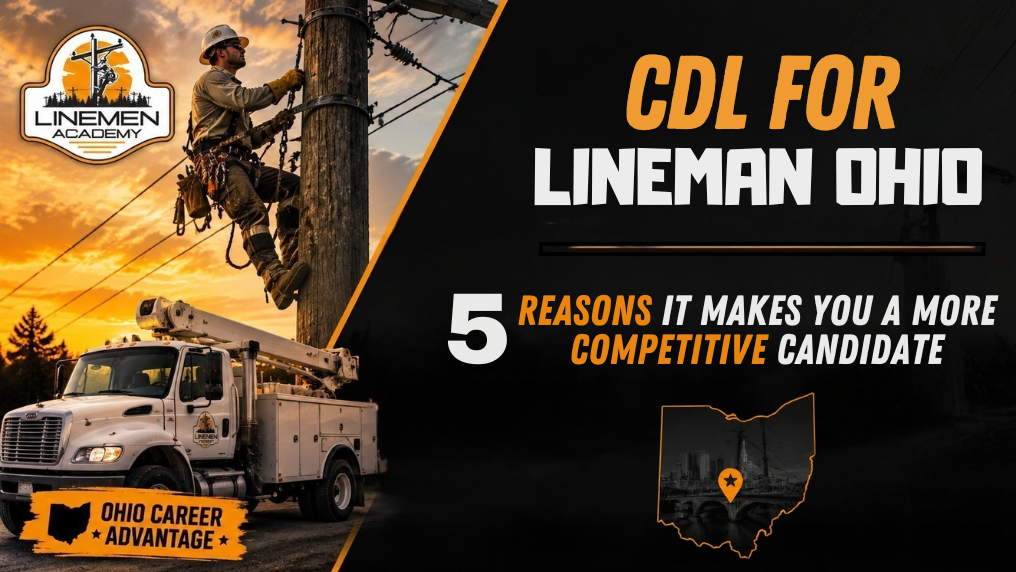
A commercial driver’s license (CDL) makes you a significantly more competitive lineman candidate in Ohio because the vast majority of utility employers require one, either at the time of application, upon hire, or within 60 days of starting. Candidates who already hold this credential demonstrate job-site readiness, reduce onboarding costs for employers, and move to the top of applicant pools faster.
Key Takeaways
- Most Ohio lineman and groundman job postings require a valid Class A or Class B commercial driver’s license
- Licensed drivers can legally operate bucket trucks, digger derricks, and heavy line trucks from day one
- Combined lineman pre-apprenticeship + CDL training earns you two credentials in weeks, not years
- Linemen Academy in Milford, Ohio offers CDL training as part of its 7-week pre-apprenticeship program
Ohio’s utility employers aren’t just looking for willingness. They’re looking for trade candidates who are ready to contribute from week one. That’s exactly why a commercial driver’s license has become one of the most practical advantages an aspiring utility worker can bring to an interview. Here are five concrete reasons the CDL separates competitive applicants from the rest of Ohio’s hiring pool.
What Is a CDL and Why Does It Matter for Linemen?
A Commercial Driver’s License is a federally regulated credential that authorizes a driver to operate heavy commercial vehicles above 26,001 lbs GVWR. In the utility trades, this license is required to operate the bucket trucks, digger derricks, and cable-reel trailers that line crews use every single day on the job site.
Ohio issues three classes: Class A (combination vehicles), Class B (single heavy vehicles such as bucket trucks), and Class C (hazmat/passenger). For lineman work, Class A offers the broadest operating coverage and is preferred or required by most major utility employers including AEP Ohio and FirstEnergy contractors.
Reason 1: Most Ohio Lineman Job Postings Already Require One
Research into utility positions found that the vast majority require a valid commercial driver’s license upon applying, upon hire, or within 60 days of starting. Ohio job boards reflect this same pattern, active journeyman lineman listings list Class A as preferred, while a significant share of groundman and apprentice postings require it at the time of application. Learn exactly how to obtain a CDL step by step as an electrical lineman
When an employer receives 40 applications and 30 candidates need CDL sponsorship before they can move a truck, the 10 who already hold one move to the front automatically. You’re not just meeting a requirement, you’re removing a hiring barrier that eliminates most of your competition.
What Ohio Employers Typically Require:
- Class A or Class B commercial driver’s license
- Clean motor vehicle record (MVR)
- DOT physical and drug screen clearance
- Ability to operate boom equipment, digger derricks, and heavy line trucks
Reason 2: You Can Operate Critical Equipment From Day One
Bucket trucks, digger derricks, and utility line trucks all require a commercial driver’s license to operate legally on Ohio roads. A groundman or apprentice who can legally drive this equipment isn’t just an extra body on the crew, they’re a functional contributor who keeps work moving.
New apprentices quickly realize that much of their early work involves supporting the crew on the ground before they ever climb a pole. Being CDL-licensed, from a digger derrick to a bucket truck, makes an apprentice far more valuable and ensures smoother, safer job site operations. Pair that with knowing the essential tools every lineman needs on the job and you show up genuinely field-ready.
Reason 3: It Demonstrates Professional Commitment Before the Interview
Showing up to an interview with your commercial driver’s license already in hand tells a hiring manager three things: you invested in your career, you understand what utility work requires, and you’ve already cleared a significant regulatory hurdle. That combination is rare — and foremen notice.
In competitive IBEW locals throughout Ohio where apprenticeship slots are limited, the CDL can be the differentiating factor that opens the career path. A commercial driver’s license on your resume, alongside pre-apprenticeship training, is a credible signal that you’ve done the real preparation. See specifically how a CDL helps you advance in a lineman apprenticeship
Reason 4: It Expands the Range of Jobs You Can Apply For
Without a commercial driver’s license, your utility job search in Ohio is narrower than it needs to be. Entry-level roles such as groundman, equipment operator, and line crew assistant often list Class A or B as a hard requirement — not a preference.
With your CDL in hand, you can apply across a much wider range of utility, contractor, and telecom positions statewide. Thayer Power & Communication, Star Construction, and independent contractors supporting AEP Ohio and FirstEnergy infrastructure all require it. Groundman roles at smaller regional contractors also typically require the license before a candidate can be considered field-ready. If you’re still deciding on a school, this guide on how to choose the right lineman school program is worth reading first.
| Factor | Without CDL | With CDL |
| Entry-level job postings eligible to apply | Limited | Full range |
| Can operate bucket trucks and digger derricks | No | Yes |
| Meets most Ohio utility employer requirements | Partially | Yes |
| Competitive edge in IBEW application | Moderate | Strong |
Reason 5: It Increases Your Long-Term Earning Power
The mean annual salary for electrical power line installers and repairers was $85,900 in 2023, with top earners reaching $119,920 per year. Line technicians who can operate heavy equipment, bucket trucks, digger derricks, are more deployable and more likely to qualify for overtime and storm response assignments, where earnings spike significantly.
The trade is projected to grow 8% from 2023 to 2033. As the industry expands and experienced journeymen retire, candidates who enter with the most complete credential stack will have the strongest negotiating position on pay. For a full picture of the career path, the complete guide to becoming a lineman covers training, skills, and earning milestones in depth.
Two candidates complete the same pre-apprenticeship program. One holds a commercial driver’s license; one doesn’t. When storm restoration overtime opens up and the crew needs someone to move a bucket truck at 2 a.m., the CDL holder gets the call, and thousands more in annual earnings.
How Linemen Academy Combines CDL and Lineman Training in Ohio
Linemen Academy, located in Milford, Ohio, integrates commercial driver’s license training directly into its lineman pre-apprenticeship curriculum. Students complete both within a single compact 7-week schedule.
The Class A CDL component covers Ohio traffic laws, accident reporting, vehicle maneuvering, pre-trip inspection, and in-cab instruction, the exact skills DOT examiners assess. This is layered alongside climbing, equipotential grounding, bucket truck operations, digger derrick introduction, rigging, pole-top rescue, and CAST exam preparation. Read more about what the pre-apprenticeship program covers before you enroll.
Graduates leave with a CDL and a lineman pre-apprenticeship certification, positioned to apply for a much wider range of utility roles statewide than either credential alone would allow.
Linemen Academy also offers CAST exam prep, career planning, and preferred job placement assistance. Ohio Reg. No. 2281. GI Bill accepted. Questions? Check the FAQ or contact the team.
Conclusion
A commercial driver’s license isn’t just a box to check, it’s a competitive signal that tells Ohio utility employers you can operate their equipment, you understand compliance, and you come prepared. Pair it with a lineman pre-apprenticeship certification and you walk into the job market with exactly what employers need to see.
Frequently Asked Questions
Does a lineman in Ohio need a CDL? Most Ohio lineman and groundman roles require a Class A or Class B commercial driver’s license at the time of application or within 60 days of hire. Candidates who already hold it are consistently more competitive statewide.
How long does it take to get a CDL in Ohio? Typically 3 to 4 weeks of structured instruction and testing. When combined with lineman pre-apprenticeship training at Linemen Academy, you earn both credentials within one program. The complete guide to CDL training programs covers what to expect in detail.
What is the starting salary for a lineman in Ohio? Entry-level wages typically range from $48,000 to $65,000 annually. With overtime, storm response, and specialized equipment work, experienced journeyman linemen regularly earn $85,000 to over $100,000 per year.