

If you’re considering a career as a lineman, one of the first questions you may have is, “Do you need a degree to become a lineman? In most cases, a traditional four-year degree is not the standard starting requirement. Instead, employers and apprenticeship programs typically look for a combination of basic education, safety awareness, physical readiness, driving qualifications, and practical training.
For aspiring lineworkers in Ohio, including those in Milford and surrounding areas, a career-focused lineman training program can provide practical preparation before pursuing an apprenticeship or entry-level opportunity. Similar training pathways are available to individuals exploring lineman careers across the USA, helping them build hands-on skills and industry-specific qualifications before entering the trade.
The Short Answer: No, a Degree Usually Isn’t Required
You generally do not need a four-year degree to begin preparing for a career in utility linework. However, that does not mean you can enter the trade without any preparation.
Many aspiring lineworkers start with a high school diploma or GED, then complete lineman training to develop practical skills and understand the demands of the job. Depending on the employer or apprenticeship, additional requirements may include a valid driver’s license, CDL qualifications, physical readiness, and the ability to successfully complete safety and aptitude requirements.
The important distinction is that how to become a lineman without a degree does not mean skipping education or training. It means choosing education that is directly connected to the work you want to perform.
What Are the Minimum Education Requirements for a Lineman?
The right lineman training program should prepare you for the physical, technical, and safety requirements of utility linework, not simply provide classroom information.
High School Diploma or GED
A high school diploma or GED is commonly used as the basic education requirement for lineman training and career pathways. Specific requirements can vary by school, employer, or apprenticeship.
Career-Focused Lineman Training
Before applying for an apprenticeship, structured training can help you build familiarity with the work and develop foundational skills.
A quality pre-apprenticeship lineman training program may cover:
- Basic electrical theory and electricity
- Pole climbing and work-at-height safety
- Personal protective equipment and jobsite safety
- Basic line construction
- Tools and equipment used in linework
- Grounding and rigging
- Bucket truck and line-truck awareness
- Rescue and emergency procedures
- Career and apprenticeship preparation
Linemen Academy’s training in Milford, Ohio, combines classroom instruction with practical training, including climbing, electrical fundamentals, equipment, rescue, safety, and other linework skills.
If you want to understand the broader career pathway, see this guide on how to become a lineman.
Apprenticeship Training
A lineman apprenticeship is where aspiring lineworkers continue developing their skills through structured training and supervised work experience. A pre-apprenticeship program can help you understand the trade and prepare for the expectations of an apprenticeship, but completing one does not automatically guarantee an apprenticeship or job.
Driving Qualifications
Driving is also an important part of many linework careers because lineworkers may operate or work around commercial vehicles and specialized equipment.
For students preparing for this requirement, a CDL Driver Training Program can be an important part of career preparation. Linemen Academy also offers a CDL Apprenticeship Program as part of its career-focused training options.
Can You Start a Lineman Career Without Going to College?
Yes, a degree is not the only route into the trade. A practical career pathway can look like this:
High School Diploma/GED → Lineman Training → Apprenticeship Preparation → Apprenticeship/Application → On-the-Job Training → Career Progression
This pathway is why many people interested in the trade consider a lineman school or pre-apprenticeship lineman program before applying for apprenticeships.
If you’re in Ohio, Linemen Academy’s Milford campus provides a structured seven-week pre-apprenticeship program designed around hands-on, career-focused training.
You can also review our guide on the pre-apprenticeship lineman program in Ohio to understand what to consider when comparing programs.
Start Preparing for a Lineman Career With Hands-On Training
Understanding that a degree is not required is just the initial step. The next question is where can you get the right lineman training to prepare for the trade?
A career-focused program can give you an opportunity to work on skills before you begin pursuing apprenticeships or entry-level positions.
When comparing lineman training programs, look for preparation that includes:
- Hands-on climbing practice
- Electrical fundamentals
- Safety and PPE instruction
- Linework tools and equipment
- Rescue training
- Grounding and rigging
- Basic construction and rigging
- CDL preparation
- Career and apprenticeship guidance
Linemen Academy’s pre-apprenticeship lineman program and its listed curriculum include climbing training, CDL instruction, transformers, grounding, bucket-truck rescue, basic electricity, line construction, rigging, PPE, and other practical subjects.
For a more profound look at why practical preparation matters, read about hands-on lineman training compared with online learning.
How to Choose the Right Lineman Training Program
Before enrolling, compare what each program actually includes and how closely the training reflects the work you want to pursue.
Consider:
- How much hands-on training is included?
- Do students receive climbing and safety instruction?
- Are electrical fundamentals part of the curriculum?
- Is CDL preparation available?
- Does the program prepare students for apprenticeship applications?
- Where is the training located?
- What are the admission requirements?
- What equipment and facilities are available?
- What career support is provided?
For students considering lineman training in Ohio, location can also matter. Linemen Academy is located at 5163 Wolfpen Pleasant Hill Rd, Milford, OH 45150, providing a dedicated campus for its lineman training program.
Why Choose Linemen Academy for Lineman Training?
If you’re considering lineman training in Ohio, Linemen Academy provides a focused 7-week pre-apprenticeship program at its Milford, Ohio campus. The training combines classroom instruction with hands-on experience and is designed to prepare students for the next step in a linework career.
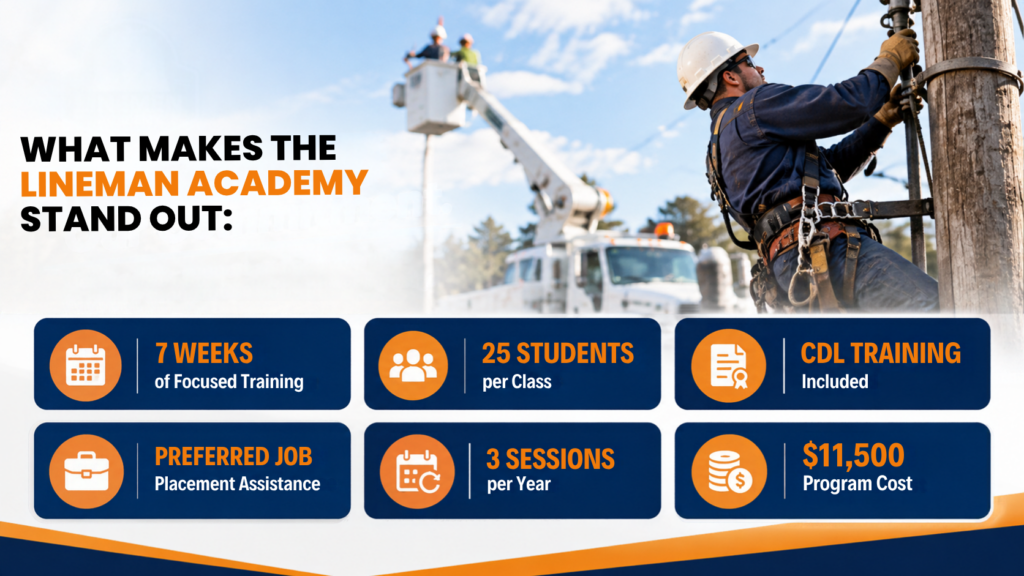
The program is designed as a career preparation pathway, not a replacement for an apprenticeship, helping students build foundational skills before pursuing the next stage of their lineman career.
If you want to review program requirements before applying, visit the FAQs.
Ready to Start Your Lineman Training?
If you’re ready to start a career in the utility and electrical linework industry, Linemen Academy provides a career-focused pre-apprenticeship program at its Milford, Ohio campus.
The program is designed to give students practical exposure to linework, safety, climbing, electrical fundamentals, CDL preparation, and other skills used in the trade.
Apply to the Linemen Academy training program to see how you can begin preparing for a career in utility linework.
Frequently Asked Questions (FAQs):
- 1. What education do you need to become a lineman?
A high school diploma or GED is typically a starting requirement. Linemen Academy accepts a high school transcript or GED for its pre-apprenticeship program.
- 2. Is CDL training included in lineman training?
Yes. Linemen Academy includes CDL training in its 7-week pre-apprenticeship program in Milford, Ohio.
- 3. What is a lineman pre-apprenticeship program?
A pre-apprenticeship program provides foundational skills and practical preparation before pursuing an apprenticeship. Linemen Academy’s program combines hands-on training with career-focused instruction.
- 4. What are the requirements to enroll in lineman training?
Requirements vary by program, but Linemen Academy requires a high school transcript or GED. Eligible students can enroll in its 7-week pre-apprenticeship program in Milford, Ohio.
- 5. How much does lineman training cost in Ohio?
Costs vary by school. Linemen Academy provides a 7-week lineman training program at $11,500 at its Milford, Ohio, campus.
- 6. What does Linemen Academy cover in its training?
Linemen Academy covers practical areas such as climbing, electrical fundamentals, line construction, grounding, rescue, PPE, equipment, and CDL training to help prepare students for the next stage of their lineman career.
- 7. How do I start a lineman career in Ohio?
Start by meeting the basic education requirements and gaining practical skills through a career-focused lineman training program. Linemen Academy’s 7-week pre-apprenticeship program in Milford, Ohio, provides hands-on training and CDL training to help prepare you for the next step toward an apprenticeship or entry-level opportunity.